
In today's digital world, cyber threats are evolving faster than ever. Organizations are no longer defending against only malware or phishing emails—they're facing ransomware, supply chain attacks, insider threats, cloud misconfigurations, and AI-powered cyberattacks.
A strong cybersecurity team isn't defined by the tools they use; it's defined by the security culture they build.
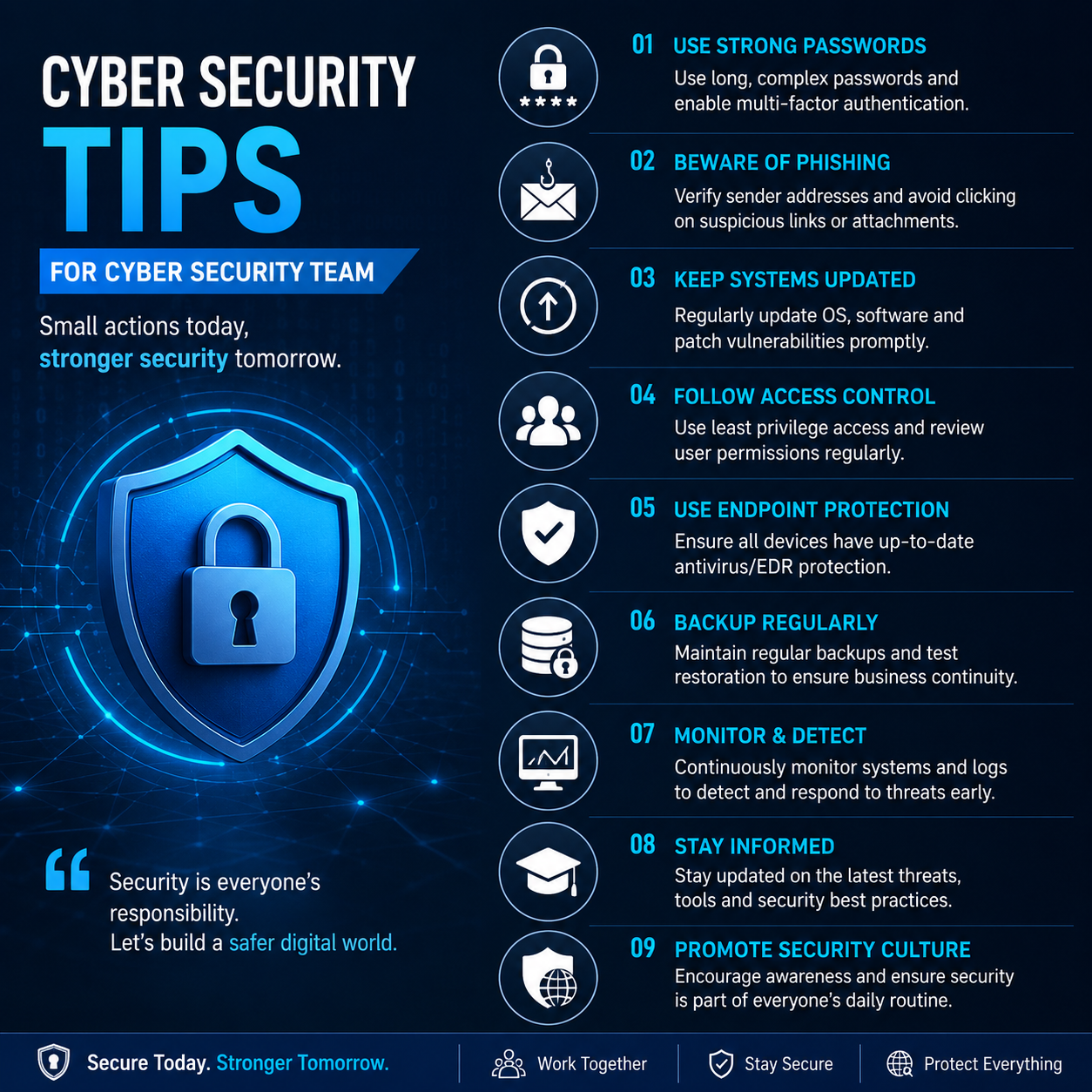
Here are nine essential cybersecurity practices that every security team should follow to strengthen their organization's security posture.
1. Use Strong Passwords and Multi-Factor Authentication (MFA)
Weak passwords remain one of the easiest ways for attackers to gain unauthorized access.
Best practices:
- Use long, unique passwords for every account.
- Implement password managers.
- Enable Multi-Factor Authentication (MFA) on all critical systems.
- Remove default credentials immediately after deployment.
Remember: A strong password combined with MFA can prevent the majority of credential-based attacks.
2. Stay Alert Against Phishing
Phishing remains one of the most successful attack techniques because it targets people instead of technology.
Security teams should:
- Verify email senders.
- Inspect links before clicking.
- Block suspicious domains.
- Conduct regular phishing simulation exercises.
- Train employees to identify social engineering attempts.
Security awareness is just as important as firewall protection.
3. Keep Systems Updated
Every software update fixes vulnerabilities that attackers actively search for.
Ensure:
- Operating systems are patched regularly.
- Applications are updated promptly.
- Firmware is kept current.
- Vulnerability scans are performed frequently.
- Critical security patches are prioritized.
Delaying updates gives attackers more opportunities to exploit known weaknesses.
4. Apply the Principle of Least Privilege
Users should only have access to the resources required for their role.
Implement:
- Role-Based Access Control (RBAC)
- Privileged Access Management (PAM)
- Regular permission reviews
- Immediate removal of inactive accounts
Reducing unnecessary access significantly minimizes insider and external risks.
5. Deploy Endpoint Protection
Every workstation, server, and mobile device can become an entry point for attackers.
Use:
- Endpoint Detection and Response (EDR)
- Next-Generation Antivirus (NGAV)
- Device encryption
- USB device control
- Host-based firewalls
Endpoint visibility enables faster detection and response to threats.
6. Backup Data Regularly
Backups are your last line of defense against ransomware and accidental data loss.
Follow the 3-2-1 Backup Rule:
- Keep 3 copies of your data.
- Store them on 2 different types of media.
- Maintain 1 offline or off-site backup.
Regularly test backup restoration to ensure recovery is possible when it matters most.
7. Monitor and Detect Threats Continuously
Cybersecurity doesn't stop after deploying security controls.
Security teams should:
- Monitor logs 24/7.
- Collect security events using a SIEM platform.
- Detect anomalies with behavioral analytics.
- Investigate suspicious activities immediately.
- Develop and test incident response procedures.
Early detection can dramatically reduce the impact of a cyberattack.
8. Stay Informed About Emerging Threats
Threat actors constantly change their tactics.
Stay current by:
- Following threat intelligence feeds.
- Monitoring vulnerability advisories.
- Reviewing security research.
- Participating in cybersecurity communities.
- Attending conferences and webinars.
Continuous learning is one of the most valuable security controls.
9. Build a Strong Security Culture
Technology alone cannot secure an organization.
Encourage:
- Regular security awareness training.
- Clear reporting procedures.
- Collaboration across departments.
- Security-by-design principles.
- Leadership support for cybersecurity initiatives.
When every employee understands their role in protecting information, the entire organization becomes more resilient.
Final Thoughts
Cybersecurity is not a one-time project—it's a continuous process of prevention, detection, response, and improvement.
The strongest organizations don't simply react to cyber threats; they proactively build resilient systems, educate their people, and continuously improve their defenses.
Whether you're a Security Analyst, SOC Engineer, Penetration Tester, DevSecOps Engineer, System Administrator, or CISO, these nine practices form the foundation of a mature cybersecurity program.
Security isn't just the responsibility of the cybersecurity team—it's everyone's responsibility.